
Intro
Stardew Valley is over 10 years old now, yet it continues to attract new players beginning their cozy farming journey every day.
During your very first Spring, you’ll be learning how to manage your farm, explore the valley, meet the residents of Pelican Town, and level up a variety of skills. With so much to do and so little energy each day, it’s easy to feel overwhelmed or make a few beginner mistakes.
That’s why I’ve put together this list of tips that helped me as a returning player starting a fresh farm. Some of these are lessons I learned the hard way while working towards perfection, while others come from the incredibly helpful Stardew Valley community.
If you’re just starting out, these tips should help make your first Spring go a little smoother and hopefully save you from a few of the mistakes I made along the way.
Don’t Plant Too Many Crops
One of the biggest mistakes new players make in their first Spring is planting too many crops.
It seems logical at first. More crops should mean more money, right? Unfortunately, every crop needs to be watered by hand, and as a new farmer you have very limited energy each day.
If you spend all your energy watering crops, you won’t have much left for fishing, foraging, mining, or clearing your farm. In the early game, these activities are often just as important for making money and progressing your farm.
That’s not to say you shouldn’t plant crops, you definitely should. But I wouldn’t recommend planting more than around 50 crops at a time during your first season. This gives you a healthy source of income while still leaving enough energy and time to explore everything Stardew Valley has to offer.
If you would like to learn more about making the most of your energy, I have an Early Game Energy Tips Guide to help you.
Dad Tip
I like planting crops in groups of 9, creating neat 3×3 squares. Four patches gives you 36 crops, which is a manageable number for your first Spring and fits nicely into future sprinkler layouts.
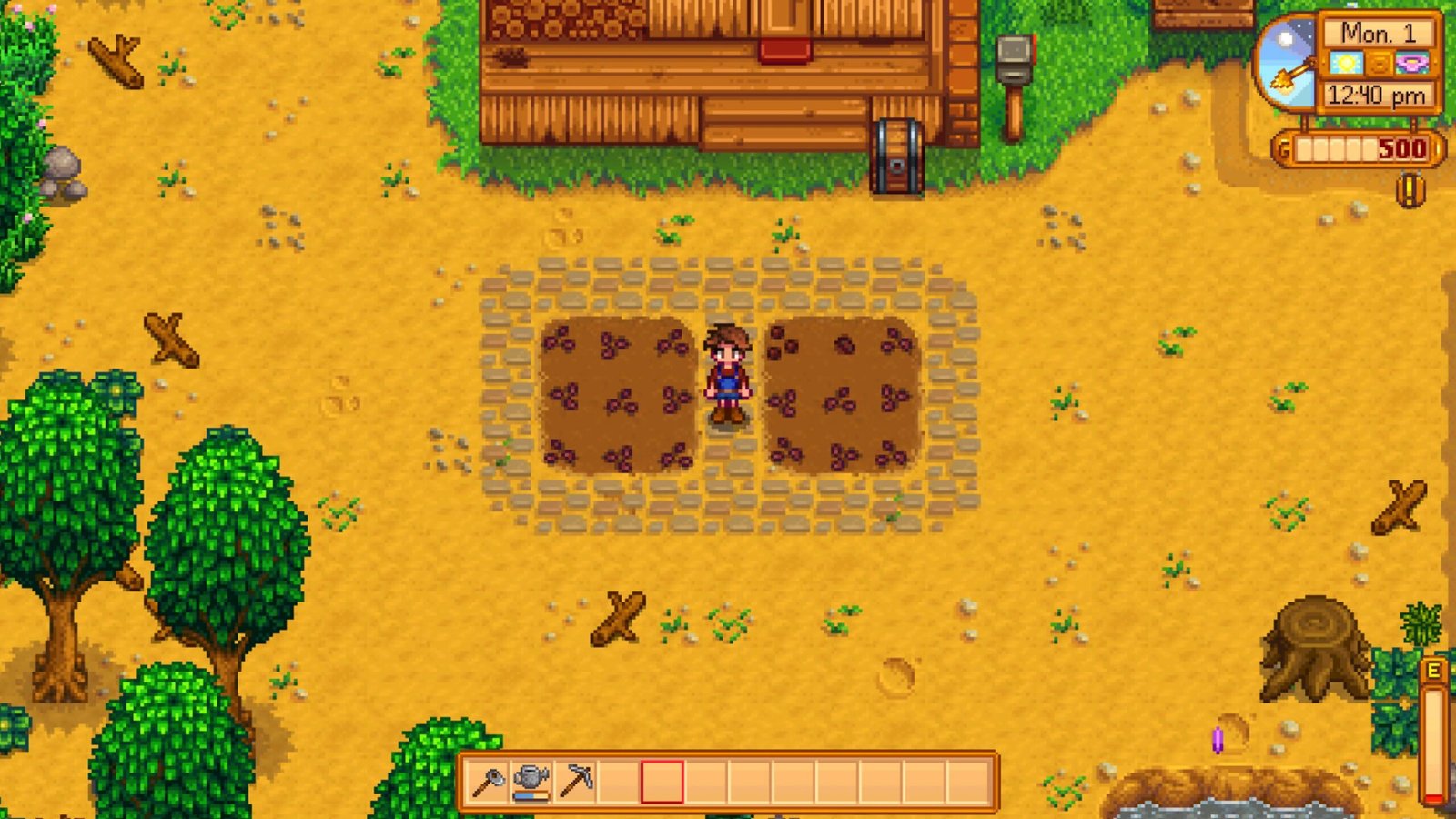
A simple 3×3 crop layout that’s easy to maintain in your first Spring
Fishing And Foraging Are King In The Early Game
My first spring was funded almost entirely by fishing
On Day 2, a fisherman named Willie will introduce himself and gift you your first fishing rod.
Fishing is one of the most profitable activities available during your first Spring. While crops take time to grow, fish can be caught and sold immediately, making fishing a fantastic way to build up your early-game income.
Different locations, seasons, weather conditions, and times of day all offer different fish, but don’t worry too much about catching specific species when you’re starting out. Focus on improving your fishing skill and selling your catches for a steady income.
DAD TIP
With limited backpack space, try fishing outside Willie’s shop by the beach. When you’re full, sell your haul straight to Willie so you can keep fishing!
While you’re exploring, don’t neglect foraging. Spring is filled with useful items like Wild Horseradish, Leeks, Daffodils, Dandelions, and Spring Onions. These can be sold for extra gold, eaten for energy, or used to craft Spring Seeds once you reach Foraging Level 1.
Just remember the first tip though, you don’t need to plant every seed you find!

Upgrade Your Backpack ASAP
This is one of the best investments you can make during your first Spring.
The first backpack upgrade costs 2,000g from Pierre’s General Store and increases your inventory from 12 slots to 24. While that might sound expensive early on, the amount of time and frustration it saves is well worth the cost.
Your tools alone take up several inventory slots before you’ve even collected a single item. Add in forageables, fish, resources, geodes, crops, and you’ll quickly find yourself making constant trips back to your farm just to empty your pockets.
The upgrade becomes even more valuable once you start exploring the mines. Instead of choosing which items to leave behind, you’ll have enough space to carry ore, coal, gems, monster loot, and food all in the same trip.
The sooner you buy the backpack upgrade, the sooner you can spend your days progressing instead of managing your inventory.
DAD TIP
If you’re saving for your first backpack upgrade, spend a few days fishing. The extra inventory space will pay for itself quickly once you’re bringing home larger hauls from fishing, mining, and foraging.
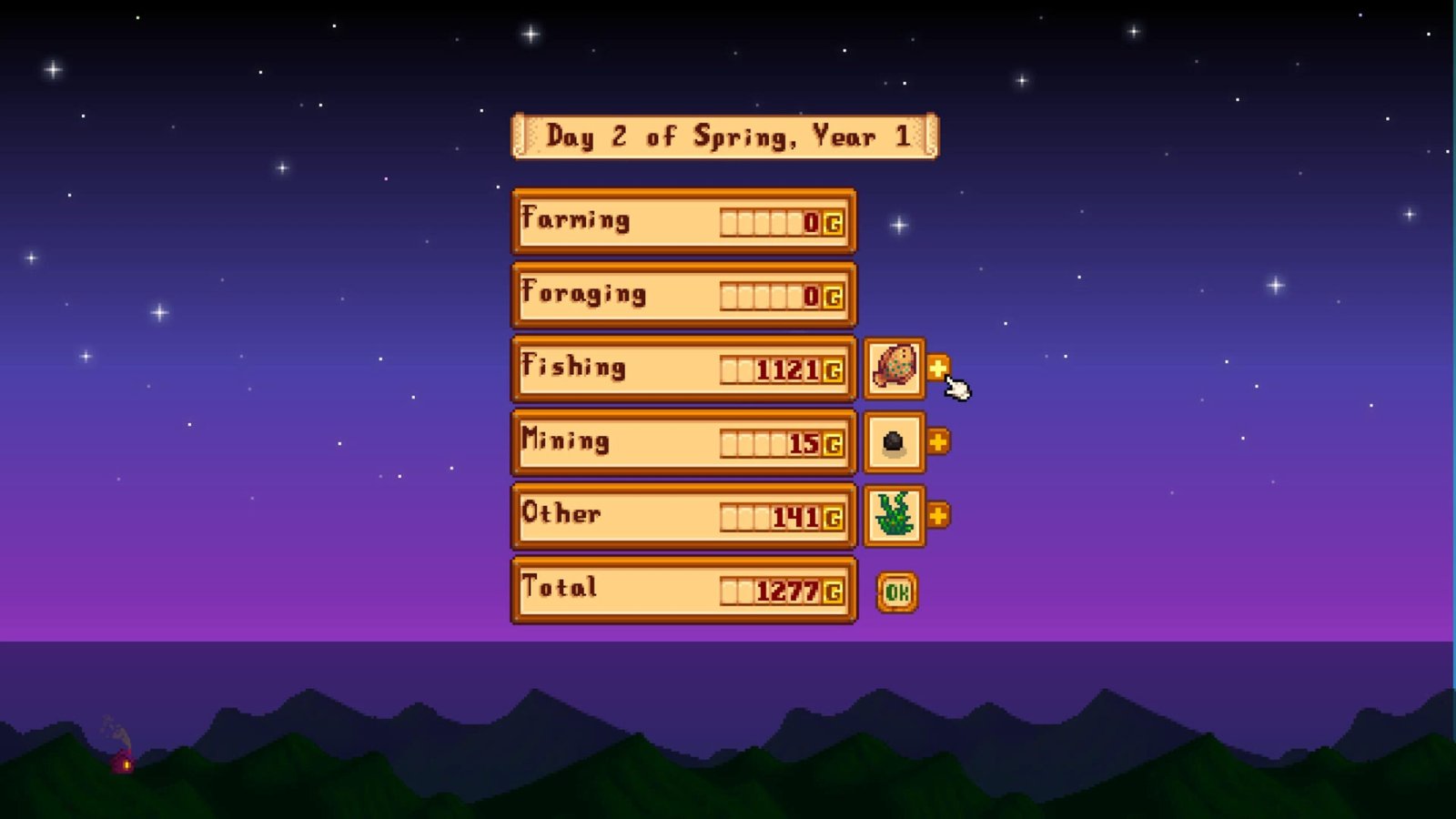
A full day of fishing and I almost have enough for a backpack upgrade.
Salmon Berries Are An Incredible Energy Source
Salmonberry Season runs from Spring 15th to 18th, and it’s one of the best opportunities to stock up on free energy early in the game.
While Salmonberries don’t restore a huge amount of energy individually, there are dozens of bushes scattered throughout the valley. A quick run around Pelican Town can leave you with a surprisingly large stack of berries.
If you’ve spent plenty of time foraging and chopping trees, there’s a good chance you’ll reach Foraging Level 4 before Salmonberry Season arrives. This will allow you to harvest double the amount of Salmonberries from a single bush.
What makes Salmonberries especially useful is that they only come in one quality, meaning your entire stash fits into a single inventory slot. That’s a huge advantage when backpack space is limited.
DAD TIP
When Salmonberry Season arrives, consider dedicating a full day to gathering berries. A good harvest can provide enough food to fuel multiple trips into the mines and may even last well into Summer.
Don’t Sell Your Resources
This is an easy mistake to make during your first Stardew Valley playthrough.
As you clear your farm, you’ll quickly start collecting wood, stone, fiber, coal, clay, and other resources. When money is tight, it can be tempting to throw these items into the shipping bin for a little extra gold.
Don’t do it.
Almost every resource in Stardew Valley is used for something important. Wood and stone are needed for farm buildings, coal is required for smelting bars, fiber is used in crafting recipes, and clay appears in a surprising number of useful items later in the game.
In fact, clay is the one your most likely to want to throw away, as you only ever have 1-2 at a time and it doesn’t feel valuable at all. But it’s also one of the more difficult resources to farm, and you will want quite a few in the late game.
The problem isn’t that these resources are difficult to find, it’s that they’re time-consuming to replace. The few hundred gold you earn from selling them usually isn’t worth the hours you’ll spend gathering them again when you need them.
DAD TIP
If your backpack is full, throw away low-value items before you throw away resources. It’s much easier to replace a daffodil or a cheap fish than it is to replace a stack of coal when you suddenly need it for crafting.
Craft Multiple Chest
This is the item management tip I wish I knew during my first playthrough.
One of the first things you’ll craft in Stardew Valley is a chest. As you chop trees, break rocks, fish, and forage around the valley, your inventory will fill up incredibly quickly.
The mistake many new players make is creating a single chest and throwing everything into it.
While that works at first, you’ll eventually spend half your time searching through a giant pile of items trying to find the one thing you need. Trust me, it gets old fast.
Instead, craft several chests early and give each one a purpose. I like placing them just outside my farmhouse so everything is easy to access.
My setup usually looks something like this:
- Resources and crafting materials
- Gems and museum items
- Mining and combat supplies
- Crops, seeds, and forageables
- Town items (geodes, gifts, community center items and museum donations)
- Miscellaneous items that don’t fit anywhere else
DAD TIP
Once you have some spare gold, buy a Workbench from Robin and place your crafting chests beside it. The Workbench can pull materials directly from adjacent chests, making crafting much faster and keeping your farm organized.
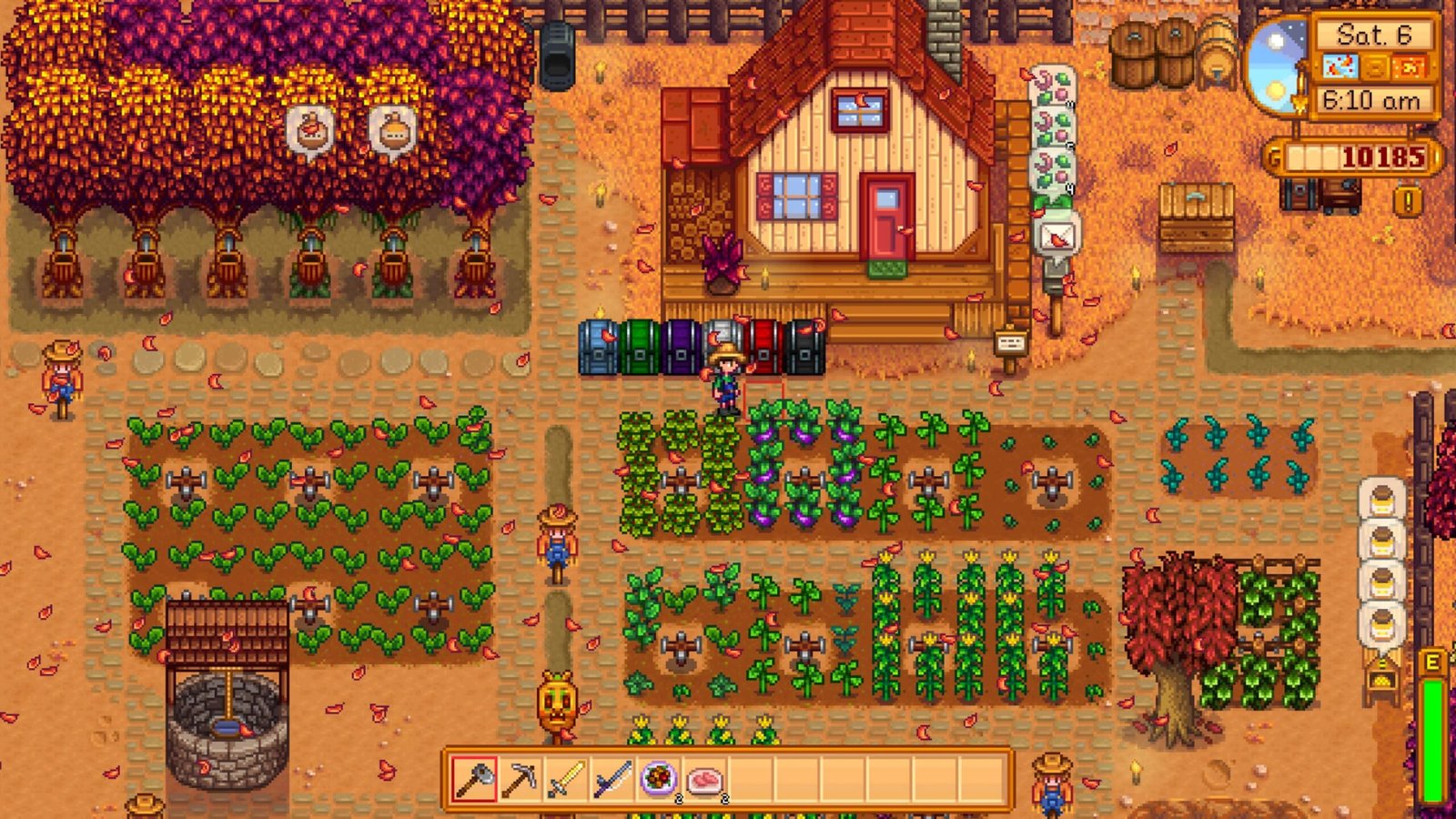
Even well into fall, my multiple chest setup still works
Save At Least One Of Everything
This tip will save you a surprising amount of frustration later on.
Stardew Valley is packed with items, recipes, bundles, quests, and hidden mechanics. When you’re starting out, it’s almost impossible to know which items will become important later.
Because of this, I recommend keeping at least one of every item you find.
That extra crop, fish, gemstone, artifact, or forageable might not seem useful right now, but there’s a good chance you’ll need it eventually. Community Center bundles are the most obvious example, but you’ll also encounter crafting recipes, quests, fish pond requests, tailoring recipes, and other surprises that require items you may have already sold.
It’s much easier to store an item for later than it is to wait an entire season for it to become available again.
Basic Sprinklers Are A Trap
A very specific yet very annoying beginner mistake.
When I first unlocked sprinklers at Farming Level 2, I immediately started grinding the mines for resources. I assumed they would water all eight surrounding tiles, so I thought I was about to automate my farm nice and early.
I was wrong.
Basic Sprinklers only water four tiles: above, below, left, and right. That makes them awkward to build around, and there aren’t many clean crop layouts that make them feel worth the effort.
While automating your watering sounds like the obvious goal, the time and resources needed to craft Basic Sprinklers usually aren’t worth it. You’re better off waiting until Farming Level 6 and crafting Quality Sprinklers instead.
Quality Sprinklers water all eight surrounding tiles, which makes them perfect for the simple 3×3 crop layout mentioned earlier.
Don’t waste your time and resources on Basic Sprinklers. Save your bars and invest in Quality Sprinklers or better.
Check Your TV Daily
Do not overlook the value of checking your TV.
The TV is one of the most useful tools available to you from Day 1. It’s the first thing I check every morning.
The weather forecast allows you to plan your days in advance. If rain is coming tomorrow, you won’t need to water your crops, freeing up time and energy for other activities. Rainy days are perfect for long mining sessions or catching fish that only appear in wet weather.
You should also check your daily luck by watching the Fortune Teller. Luck affects many aspects of Stardew Valley, but it is especially important in the mines. On lucky days you’ll find ladders more easily, making it easier to reach deeper floors and gather valuable resources.
On unlucky days, consider focusing on less luck-dependent activities like fishing, chopping trees, organizing your farm, or giving gifts around town.
The TV also provides useful programming throughout the week. ‘Living Off the Land’ offers helpful beginner tips, while ‘The Queen of Sauce’ teaches new recipes that can be difficult to obtain elsewhere.
DAD TIP
A rainy day with high luck is one of the best opportunities in Stardew Valley. Bring some food, head to the mines early, and see how deep you can go.
Don’t be afraid to use the Stardew Valley Wiki or Reddit Sub
There is so much to discover in Stardew Valley that even after hundreds of hours, you’ll still find yourself looking things up.
Fortunately, the Stardew Valley Wiki is one of the best resources out there. Whether you’re trying to figure out what an item is used for, what gifts an NPC loves, or how a particular machine works, chances are the answer is only a quick search away.
As someone who has spent over 500 hours in Stardew Valley, I still regularly use the wiki. I’ve used it to find villager gift preferences, discover fish pond rewards, plan Community Center bundles, and check tailoring combinations.
If you can’t find what you’re looking for on the wiki, the Stardew Valley subreddit is another fantastic resource. The community is friendly, knowledgeable, and always discussing everything from efficient farm layouts to hidden game mechanics and lore.
Remember: using the wiki isn’t cheating, it’s simply another tool to help you enjoy the game.
DAD TIP
Don’t let perfect efficiency get in the way of having fun. Use the wiki when you’re stuck, but leave yourself room to discover some of Stardew Valley’s secrets naturally.
Conclusion
Stardew Valley can feel overwhelming when you first step onto your farm. With limited energy, inventory space, and money, it’s easy to make mistakes during your first Spring.
The good news is that there are very few mistakes in Stardew that can’t be fixed. Whether you accidentally sold an important item or planted far too many crops, every season is another opportunity to improve your farm and try something new.
I hope these beginner tips serve you well, and help you avoid some of the same mistakes I made during my first playthrough.
More Stardew Valley Guides
Enjoy this article and want more Stardew Valley? Here are some more guides to help you on your farming journey: